LASIK eye surgery has corrected astigmatism alongside nearsightedness and farsightedness for years, and modern lasers can address its uneven curvature with high accuracy. At Batra Vision Medical Group, advanced corneal mapping and laser technology help determine whether LASIK is right for your eyes based on your type of astigmatism, its strength, and your corneal health.
Keep reading to learn more about LASIK for astigmatism, who is a good candidate for the procedure, and whether it could be your key to visual freedom.
What Astigmatism Does to Your Vision

A healthy cornea is evenly curved, like the surface of a basketball. With astigmatism, the cornea often curves more steeply in one direction than the other, more like a football. Light entering the eye then focuses on more than one point instead of landing on a single sharp point on the retina.
The result is vision that looks blurred or stretched at any distance. People with astigmatism often notice eye strain, headaches after reading or screen work, squinting, and trouble seeing clearly while driving at night.
Mild astigmatism, especially when it occurs alongside nearsightedness or farsightedness, is extremely common, and many people have a small amount without realizing it. Once it starts to interfere with daily tasks like reading, driving, and working, it’s worth discussing correction.
How LASIK Corrects Astigmatism
LASIK corrects vision by reshaping the cornea so light focuses properly onto the retina. For astigmatism, the laser removes microscopic amounts of tissue in a precise pattern that evens out the steeper and flatter curves, giving the cornea a more symmetrical surface.
The Batra Vision team performs all-laser LASIK, using one laser to create the thin corneal flap and a second laser to reshape the tissue beneath it. The practice was the first in the United States to perform a commercial LASIK procedure on the Allegretto WaveLight 500 platform, a system designed for speed and stability during treatment.
Its Wavefront technology creates a detailed map of how light travels through your eye, capturing the specific imperfections that affect your vision. That information goes directly to the computer controlling the laser. Many patients who have Wavefront-guided LASIK report sharper contrast and better vision in dim light, both of which are common complaints among people with astigmatism.
Who Is a Good Candidate for LASIK With Astigmatism?
Most people with low to moderate regular astigmatism are candidates for LASIK, provided the rest of the eye is healthy. Higher amounts can sometimes be treated, though the limit varies by patient and laser platform. Several factors shape the decision:
Source of the Astigmatism
LASIK works on the cornea. Astigmatism that comes mainly from the eye’s natural lens may be better addressed with a lens-based procedure like RLE.
Prescription Stability
Your prescription should stay steady for at least a year before surgery. If your prescription is still shifting, it could nullify your LASIK results. This is also why women who are pregnant are advised to wait until after they have given birth and completed nursing, because hormonal changes can affect prescriptions.
Corneal Thickness
LASIK involves creating a thin flap on the surface of the cornea, so the cornea must be thick enough to safely create this flap. For patients with thinner corneas, PRK is an excellent LASIK alternative that offers similar results, but with a slightly longer recovery time.
Corneal Shape and Health
Keratoconus, a progressive condition in which the cornea thins and bulges into a cone shape, causes irregular astigmatism that LASIK can make worse. People with keratoconus aren’t LASIK candidates, but they still have options, including corneal cross-linking to slow progression and INTACS to improve corneal shape.
What Happens at a LASIK Consultation?
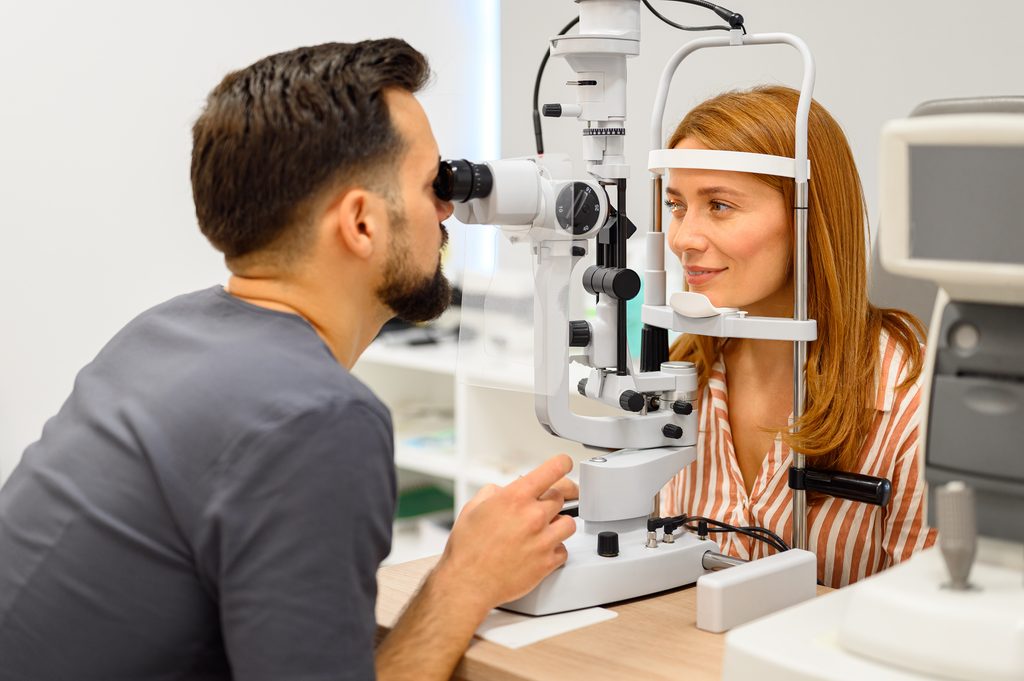
A LASIK evaluation goes well beyond a standard vision check. The team at Batra Vision Medical Group measures your astigmatism strength and axis, maps your cornea’s curvature and thickness, and looks for signs of keratoconus, dry eye, or other conditions that could affect the outcome. If you haven’t had a comprehensive eye exam recently, that baseline information also gives eye doctors a clear picture of your overall eye health.
You’ll also have the opportunity to discuss your lifestyle and vision goals with your eye doctor, ensuring the procedure you choose aligns with them. Before booking, our online LASIK self-test can give you a quick sense of whether laser vision correction might suit you. It doesn’t replace a comprehensive consultation, but it can help you arrive with a better idea of what to expect.
Recovery and Results With Astigmatism

Recovery from LASIK for astigmatism looks much like recovery from LASIK for nearsightedness or farsightedness. Most patients notice improved vision within a day or two. Mild discomfort, tearing, and light sensitivity are common for the first several hours. Glare, halos, and reduced night vision can occur during the first few weeks and usually settle over time.
For most patients, the reduction in astigmatism lasts for many years because the corneal change is permanent. After LASIK, you can look forward to decades of hassle-free, clear vision for all of life’s important moments and the activities that matter most to you.
Tired of glasses or toric contacts that never quite give you crisp vision? Schedule an appointment at Batra Vision Medical Group in San Leandro, CA, today to see if LASIK could be right for you.


 Follow Us!