
If you’re under 30 and your glasses prescription seems to change every few months, or if your contact lenses no longer give you the clear vision they once did, keratoconus may be the reason. This progressive eye condition reshapes the cornea over time, making it increasingly difficult to correct vision with standard lenses and, in some cases, even requiring corneal transplantation.
For many patients, the idea of needing a corneal transplant can feel overwhelming. The good news is that INTACS corneal inserts offer a less invasive approach to managing keratoconus by reshaping the cornea from within.
Keep reading to learn how INTACS work, what the procedure involves, and how the team at Batra Vision Medical Group can help restore your functional vision.
What is Keratoconus?
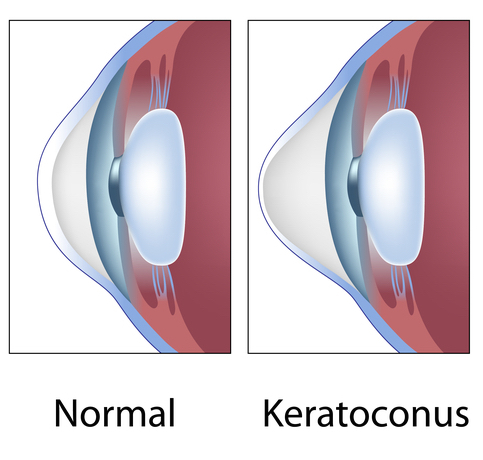
Keratoconus is an eye condition that causes the cornea (the clear, dome-shaped front surface of the eye) to gradually thin and weaken. As the cornea loses its structural integrity, it bulges outward into an irregular, cone-like shape.
This alters how light enters the eye, leading to blurred, distorted vision that worsens over time. Keratoconus typically presents during your teenage years and progresses through your 20s before stabilizing somewhat in your 30s or 40s. The exact cause remains unknown, but genetics, allergies, and environmental factors may all contribute.
In its early stages, keratoconus can often be managed with glasses or soft contact lenses. As the condition progresses, rigid gas-permeable lenses may help maintain a more consistent corneal shape. When these options no longer provide adequate vision, surgical treatments may become necessary.
How INTACS Treat Keratoconus
INTACS are small, crescent-shaped prescription inserts made of polymethylmethacrylate (PMMA), a medical-grade plastic used safely in ophthalmic devices for more than 40 years. These implants are placed within the middle layers of the cornea, outside the central optical zone, where they gently flatten and reshape the tissue from within.
By restoring a more natural, dome-like curvature to the cornea, INTACS reduce the irregular astigmatism and nearsightedness caused by keratoconus. The implants are positioned at approximately two-thirds of the cornea’s depth, allowing them to reshape the cornea without removing any tissue. This is a key difference from a corneal transplant, which involves removing and replacing a section of the cornea with donor tissue.
INTACS are approved by the U.S. Food and Drug Administration for the treatment of keratoconus and mild myopia. They are available in different thicknesses, and your ophthalmologist will select the appropriate size based on your individual corneal measurements and the severity of your condition.
Benefits of INTACS Over a Corneal Transplant

A corneal transplant is a major surgical procedure with a long recovery period, and it involves replacing part of your own cornea with donor tissue. INTACS offer several advantages for patients seeking an alternative.
Because the procedure reshapes the existing cornea rather than removing tissue, recovery time is significantly shorter. Most patients notice visual improvement quickly and return to their normal activities within a few days.
Another advantage is flexibility. INTACS are designed to be a long-term solution, but they can be removed or replaced if a patient’s needs change over time.
If a corneal transplant becomes necessary in the future, patients who have had INTACS typically experience no additional complications from the prior procedure. The primary goals of INTACS for keratoconus are to restore functional vision and delay or eliminate the need for a corneal transplant.
Results will vary from patient to patient, depending on each person’s unique corneal shape and thickness. Some patients find they no longer need prescription lenses after the procedure, while others still require glasses or contacts for their best corrected vision.
What to Expect During the INTACS Procedure
Your ophthalmologist will begin by performing a thorough eye examination that includes a variety of standard tests, corneal measurements, and a review of your medical history. These evaluations help determine whether you are a good candidate for INTACS and which implant thickness is right for you.
On the day of your procedure, avoid applying lotion, makeup, or perfume to your face, and arrange for someone to drive you home. The INTACS procedure takes approximately 15 minutes per eye.
Your INTACS surgeon will apply anesthetic drops to numb the eye, which is held open throughout to prevent blinking. A small incision is made in the surface of the cornea, and a centering guide is placed on the eye to stabilize it and ensure proper implant alignment.
The inner layers of the cornea are gently separated, and the implants are carefully positioned. The small opening is then closed, and the procedure is complete.

Most patients resume their normal activities within two to three days. You may experience mild discomfort in the first few hours, including itching, burning, or a scratchy feeling in the eye.
Your eye doctor will likely recommend resting with your eyes closed for several hours after the procedure, wearing eye shields while sleeping for a few nights, and avoiding rubbing your eyes for several weeks. Swimming, hot tubs, and contact sports should also be avoided during the initial healing period.
Follow-up visits will be scheduled to monitor your healing and evaluate the visual benefits of the procedure. As with any surgery, there are some risks to be aware of, including infection and visual symptoms such as glare, halos, or fluctuating vision. Your ophthalmologist will discuss these with you in detail before the procedure.
Are INTACS Right for You?
INTACS are typically recommended for patients with keratoconus who cannot achieve adequate vision with glasses or contact lenses. If you have been told that a corneal transplant may be in your future, INTACS may offer an effective option to improve your vision before considering that step. The best way to find out if you are a candidate is to schedule a comprehensive eye evaluation with a corneal specialist at Batra Vision Medical Group.
Their team will work with you to evaluate your condition, explain your options, and determine the best path forward for your vision. Ready to find out if INTACS are right for you? Schedule an appointment at Batra Vision Medical Group in San Leandro, CA, today!
 Follow Us!